

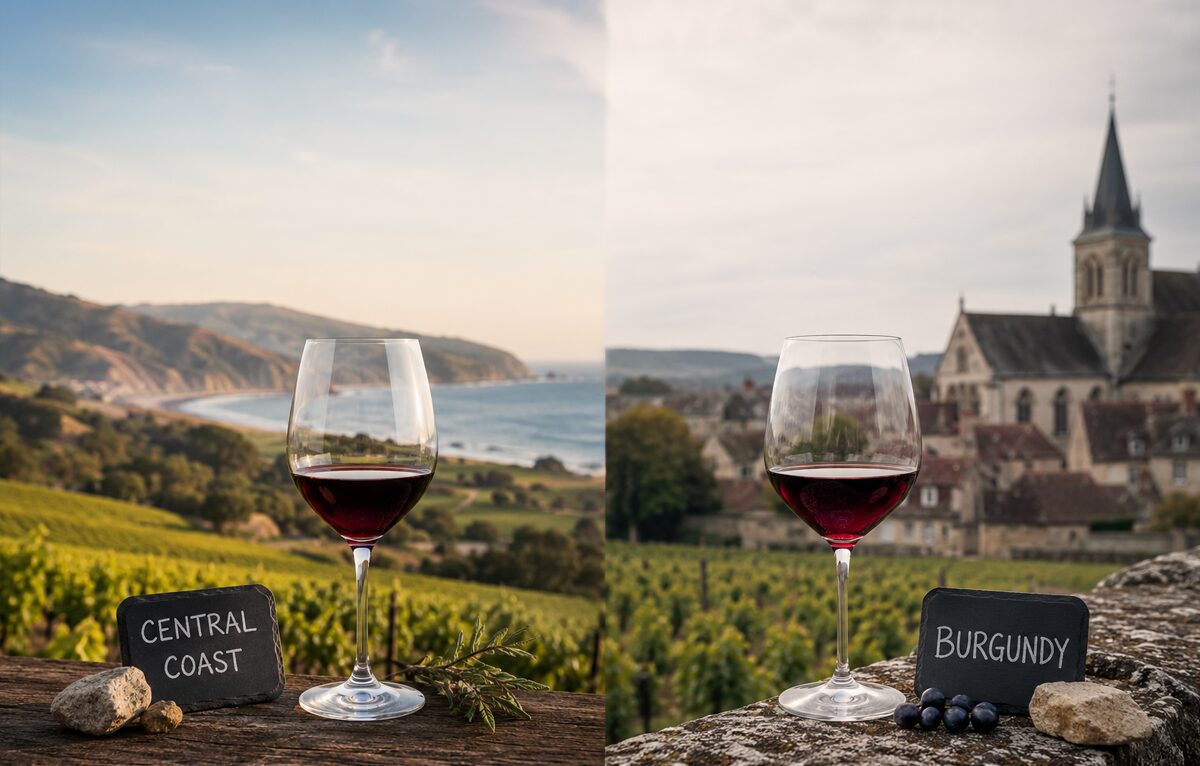
Central Coast vs. Burgundy: The Evolution of Pinot Noir
For decades, the global wine community has engaged in a continuous, deeply affectionate debate over Pinot Noir. It is a famously fussy, thin-skinned grape that acts like a mirror to the landscape, reflecting the precise dirt and air of its home with absolute transparency.
Because it is so sensitive, two well-made bottles from different sides of the globe can taste like completely different grape varieties. To understand what Pinot Noir is truly capable of, one must look at its ancestral home in eastern France, and its most compelling New World challenger along California’s sea-swept Central Coast.
This is not a matter of which region is objectively superior, but rather a fascinating study of how geography, history, and human intent shape what ends up in our glasses.
Quick Comparison at a Glance
| Feature | Central Coast Pinot Noir | Burgundy Pinot Noir |
|---|---|---|
| Location | Coastal California (San Francisco to Santa Barbara) | Eastern France (Côte d’Or and surroundings) |
| Climate | Long, sunny seasons chilled by daily ocean fog | Cool and tricky, with cold winters and spring frosts |
| Signature Soils | A patchwork of sand, clay, loam, and limestone | Ancient clay and limestone |
| Typical Style | Generous, round, fruit-forward, slightly higher alcohol | Lean, earthy, higher acidity, savoury |
| Flavour Notes | Black cherry, raspberry, plum, baking spice | Red cherry, cranberry, rose petal, damp forest floor |
| Alcohol | Typically 13.8% to 14.5% | Typically 12.5% to 13.5% |
| Price for Quality | Roughly $35 to $135 | $40 to several hundred (Grand Cru can be thousands) |
| When to Drink | Delicious young; ages nicely for 5 to 10 years | Often needs time; top wines age 15 to 30+ years |
The Continental Benchmark: Burgundy’s Climate and Soil
In Burgundy, ripening Pinot Noir has historically been a game of chance. Sitting at a tricky northern latitude, the region faces harsh winters, unpredictable summers, and the ever-present threat of spring frosts. Yet, this slow, stressful ripening is precisely what builds the structural backbone of great red Burgundy. The vines must fight for survival, a process that preserves a crisp, mouth-watering natural acidity and keeps the alcohol levels modest.
The true magic of Burgundy, however, is rooted in its ancient clay and limestone soils dating back to the Jurassic period. Over centuries, generations of vignerons meticulously mapped the hillsides into tiny, strictly defined vineyard plots called climats. A shift of just a few yards up or down a slope can completely alter the wine’s character. The rocky limestone forces the vine roots to dig deep for nutrients, infusing the wine with a distinctly stony, mineral quality.
When you pour a classic Burgundy, expect a delicate, translucent ruby hue. The nose is intellectual and deeply atmospheric, leading with tart red fruits like cranberry and pomegranate before opening up into savory notes of dried rose petals, mushrooms, and damp forest floor. On the palate, it feels lean and tightly wound in its youth, demanding patience. As it ages over one or two decades, it undergoes a beautiful transformation, evolving into a complex world of truffle, leather, and spice.
The New World Counterpart: California’s Coastal Mosaic
Thousands of miles away, California’s Central Coast approaches Pinot Noir with a completely different, yet equally honest, geographic reality. Stretching from the San Francisco Bay down to Santa Barbara, this region is undeniably sunny, but the best vineyards are surprisingly chilly. Every afternoon, freezing air is sucked inland from the Pacific Ocean, and a thick blanket of marine fog covers the vines most mornings.
In sub-regions like the Santa Rita Hills or the Santa Lucia Highlands, the grapes experience an incredibly long growing season. They can sit on the vine for weeks longer than they do in France without losing their natural acidity, thanks to those icy ocean winds. This extended “hang time” allows the fruit to develop deep color, velvety tannins, and rich, generous flavors.
The Central Coast does not have a single soil story; it is a vibrant, chaotic mosaic of sand, loam, clay, crumbly granite, and rare pockets of chalky limestone. Because the soils change so rapidly from one fence line to the next, Californian Pinot Noir can vary wildly from bottle to bottle.
“It delivers immense, fruit-driven joy from the very moment you pull the cork.”
In the glass, a Central Coast Pinot Noir shows a much deeper, darker color. The fruit is ripe and luscious—think black cherry, plum, and boysenberry—often wrapped in a warm, comforting hint of baking spice and vanilla from time spent in French oak barrels. While the cool coastal nights ensure the wine remains refreshing, the texture is rounder, richer, and far more immediately welcoming than a young Burgundy.
At the Table: Finesse vs. Generosity
Ultimately, these two styles reflect the cultures and the tables that inspired them.
The traditional red Burgundy is a deeply gastronomic wine, built to harmonize with classic, slow-cooked European dishes. Its high acidity and structural grip are designed to cut through the rich earthiness of a classic kosher beef bourguignon (utilizing rich beef or lamb bacon), slow-roasted lamb, or dishes featuring wild chanterelles and truffles. It is a wine that rewards curiosity, shifting and changing in your glass over the course of an evening.
The Central Coast Pinot Noir, by contrast, speaks to a lifestyle of immediate pleasure and reliable warmth. It is incredibly versatile, pairing just as beautifully with a casual weeknight roast chicken or grilled salmon as it does with richer dishes like roasted duck. It is a generous, approachable style that greets the drinker with open arms.
Discovering the Contrast
To truly understand this dialogue between the Old World and the New, nothing beats tasting the wines side-by-side.
You might start on the Central Coast with the 2023 Timbre Riverbench Pinot Noir from the Santa Maria Valley, which perfectly captures the region’s signature balance of lush black fruit and bright coastal freshness. Or look to the 2024 Kleinlerer Pinot Noir from Carneros, where the heavy fog off the San Pablo Bay creates a leaner, highly nuanced wine with a lovely herbal lift that acts as a perfect bridge between the two styles.
Then, cross the Atlantic to the cellars of Burgundy with a producer like JP Marchand. His 2023 Côtes de Beaune offers a soft, accessible introduction to French terroir, filled with bright red cherry and a gentle, earthy finish. For a deeper look into Burgundy’s structure, his 2023 Aloxe Corton “Sous Chaillots” delivers a firmer grip and a stony, mineral backbone, while the 2023 Nuits St. Georges “Aux Herbues” showcases the classic, savory complexity of dark fruit, dried flowers, and forest floor.
Experience the Contrast
Whether you prefer the joyful, ripe fruit of California or the centuries of history in a French cellar, discover your signature style today.